
As a homeschool mom and a history buff, I get a lot of questions just like this. Parents are hesitant to expose their children to a genocidal rapist in history lessons, so they just try to hurry over the lessons about Columbus. But they (you?) believe this way because of decades of twisted history education in American schools and universities.
When I refer to the twisted history of Christopher Columbus, I’m not referring to the man himself. I’m referring to the revising of a story that was set down in print long ago. I’m talking about why you can’t just take a modern interpretation of a very old story and change it, repackage it, and judge it by modern standards. I want to show you how to avoid doing that.
Listen to this podcast episode on YouTube or wherever you get your podcasts.
In the 21st century, it’s nearly impossible to have a rational conversation about Christopher Columbus. The revisionist history population would have us hateful and bitter toward a man who they believe single-handedly committed genocide during his murderous voyage to the New World.
But there’s a lot more to the story. So who do you trust? How do you know?
Firsthand accounts and primary resources are the most accurate way to understand Columbus, his men, his times, and their actions. Columbus and his men kept journals and wrote letters. Colubmus himself was a prolific journalist, and he carefully noted his highs and his lows. He wrote about his call to spread the gospel around the world, and he wrote about his miserable failings toward God and his country. He was honest about everything that happened. It’s all there to read if people would only look.
I talk about Columbus every year, not because he’s a blameless, god-like figure, but for two reasons:
- because his achievements were world-changing
- his story illustrates just how many falsehoods Americans are willing to believe
Columbus’ history as an American heroic figure spans centuries
There was a very long period of American history where Columbus was honored for his accomplishments. In fact, Columbia was the name debated for our country, and it was informally called this for two centuries.
Before there was the Statue of Liberty, there was another Lady Liberty, and her name was Columbia. Columbina, or Columbia, is the feminine form of Columbus, and before 1700, Columbia came to represent the colonies, and after the revolution was won, came to represent Liberty and the United States of America.
Now, if you search the web for the history of this fact, you’ll find writers who tell you that the newly freed colonies were scrambling for something non-British, and that they hastily adopted the moniker of Columbia for lack of anything better. But that’s simply not true.
Columbia:
1697: Samuel Sewall wrote of “Columbina” as an emblem of a new heaven in the American colonies. https://www.ourcolumbia.com/1690-1799
By the 1730s, the name “Columbia” became shorthand for the Thirteen Colonies.
1738: The term “Columbia” as a reference to America, was first used in the London publication “Gentleman’s Magazine” in 1738. (Source)
1784: After the colonists declared “no more kings,” King’s College was renamed Columbia College.” (Source)
1786: Columbia, South Carolina, became the first United States city to be named in honor of explorer Christopher Columbus. Leaders in the state legislature at that time were trying to determine where the state capitol should be located and what its name should be. Legislator John Gervais suggested Columbia, a feminine version of the name Columbus, and, while some wanted the town to be called “Washington,” the name “Columbia” won by a vote of 11-7. (The Standard)
1787 Future President John Quincy Adams, son of future president John Adams, gives his Harvard graduation speech, with the phrase, “Ye Daughters of Columbia Your Country Calls…”
1787: Two ships (Columbia & Washington) first set sail towards the Northwest coast in 1787. John Kendrick was Captain of the Columbia at first, and Captain Robert Gray led the Washington.
1789 – The Columbia (aka Rediviva) becomes the first U.S. Ship to circumnavigate the globe. Captain Robert Grey, discovered the mouth of the Columbia River in the year 1792. He named the river Columbia, after his ship.
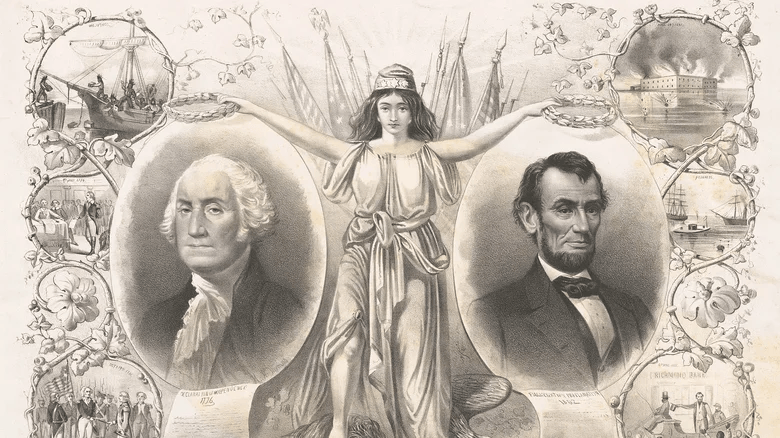
1790 In 1790 the U.S. Congress established a 100-square-mile territory to serve as the permanent seat of the federal government. (The territory was later named the District of Columbia, within which the city of Washington was built.)
1793 Hail Columbia! Columbia Hail! was an Independence Day celebration song.
By the Revolutionary era, Columbia had evolved into a neoclassical goddess. “Hail Columbia,” became the unofficial national anthem sung throughout the 19th century. (It is still the ceremonial entrance march for the Vice President of the United States.)
Columbia appeared in political cartoons, guiding westward expansion as the spirit of Manifest Destiny. She led the way westward in John Gast’s famous painting American Progress, lighting the horizon as she soars above telegraph wire, railroads, and travelers.

1893: The Chicago world’s Fair was also called the World’s Columbian Exposition, but it was to be the end of her reign. The Statue of Liberty had come to America in 1886, and she eventually took the place of Columbia as “lady liberty.” Uncle Sam also gained prominence, taking Columbia’s place on war posters. (source)
Columbia Pictures adapted lady liberty as their logo, and it still remains today.

In 1931, “The Star-Spangled Banner” officially replaced “Hail Columbia” as the national anthem.
Roughly 2.7 million Americans live in 54 counties, districts, cities, incorporated towns, boroughs, villages and census designated places named after Columbus (source)
Fast Forward…
Now, In more than 130 cities and at least eight states, the official holiday declared by President Franklin Delano Roosevelt has been repealed. States no longer celebrating Columbus Day include North Carolina, Vermont, Alaska, South Dakota, Oregon, Minnesota, New Mexico and the District of Columbia. In place of the Columbus Day holiday, most have instituted an “Indigenous Peoples Day” to honor the native peoples of America from various locales. (Source)
So what changed?
Columbus is one of the most clear examples of how the masses have been easily convinced to accept a clumsy revised history.
What Americans (and a lot of the western world) think about Columbus illustrates a nearly complete triumph for the progressive Marxist movement, not just in education, but in society at large.
The modern narrative of Christoper Columbus sounds something like this: He was inherently racist. He hated Indians. He was the single most destructive force in the history of the world. He was a rapist. He was an evil white male.
And the modern narrative of the Indians sounds something like this: they were minding their own business in their secluded part of the world. They were kind and loving. They were anti-war. They lived in peaceful community with all other Indians. They were happy, healthy, and safe before Columbus came.
I’m sure you’ve heard this. And I wouldn’t be surprised if you assumed it was true. It’s preached as gospel truth by well-educated people, and it’s been repeated so much in our generation that it seems to be the accepted true history.
So, where did we learn this?
Howard Zinn. In his 1980 book, A People’s history of the United States of America, he opens his “reimagined” history book with a whole new version of Columbus. He even calls it the “untold story.” But Zinn’s version is actually the original story with a lot of important facts purposefully omitted.
While quoting parts of Columbus’ journals, he carefully selects the parts that make Columbus appear to be a slaver and a heartless overseer. He weaves a tale makes Columbus appear as the genocidal rapist that the masses now believe he was. In addition, he paints a picture of the Indians as a peaceful community of friends who live in complete harmony who have never heard of murder, rape, or theft. (Watch my interview with Mary Grabar about Zinn here.)
It was Zinn who suggested renaming Columbus Day to Indigenous People’s Day.
Zinn’s history book became a standard resource for college students and professors, and made its way into high school courses across America. With the explosion of social media, his ideas became the material for thousands of influencers, cementing revisionist history as fact in the minds of millions of purposely uneducated Americans.
And here we are, homeschoolers in the 21st century, afraid to discuss Columbus, or teach our children about him, because we have fallen for the revisionist history of a card-carrying communist author whose fake history has been debunked hundreds of times over.
Parents, We need to be critical thinkers
We need to seek truth.
Critical thinkers must look at the historic record, examine it in the context of its time, and read the stories as they were written. While social media influencers pedal themselves off as historians, we cannot just allow them to snip the official narrative into pieces and then reassemble them into a more enticing story and call it good. If a historical figure was bad, we can truthfully admit that. If a historical figure was not bad, we should also be willing to truthfully admit that. But we are witnessing a movement that looks at all of history through this lens: heroes (especially the white European males) were always bad and the underdog was always good.
That’s what has happened to Christopher Columbus. But he’s not alone. It’s happened to pretty much any white European or American male in the past 500 years of world history, just to be clear. But because it’s Columbus Day, it’s a good time to start with the villain that they Marxists started with. You can see the dominoes fall from there.
Jeff Fynn-Paul, in his book“Not Stolen,” puts it this way: “They believe the only morally acceptable way to write history is to foreground exploitation of non-white people by white people.” (introduction, p. XVII)
Our biblical worldview matters
As Christians, we can look to scripture to help us form our thinking. Each human is born into sin: all skin colors, all ethnicities, humans in every culture. The Bible says that no one is without sin (1 John 1:8). There is none righteous. That includes the Indians of the North and South American continents. It also includes the white European males who came here.
They did not bring some European systemic racism, because there is no such thing. Racism does exist, but it’s sin in the heart of man that produces racism. It’s not limited to certain societies or skin colors or time periods. Columbus and his men were fallen humans like you and me. They had lofty ambitions like you and me. And unfortunately, their humanity collided with their lofty ambitions.
Before we go further, I want you to ask yourself: who is the dominant group that maligns Columbus’ achievements by calling him a genocidal rapist, and blaming him for single handedly murdering millions of Indians? The same group that screeches for the right to murder unborn babies and the same group that is mutilating the bodies of children in the name of trans identity (both in secret and in the open). Their “concern” is fake. It’s outrage activism. They aren’t concerned about what happened to the Indians. They just need an outlet for perpetual outrage.
James Lindsay, a noted researcher of Marxism states that “the issue is never the issue. The issue is always the revolution.” (See my interview with him here.)
We should and do acknowledge the wrongs done to many Indians by European settlers. But we must also face the fact that reality is much more complicated. You cannot generalize an entire people (Europeans or Indians) with one adjective; within each group were hundreds of little groups doing and believing vastly different things.
Columbus’ story
While I won’t argue that Columbus and his men were holy, righteous apostles, I want to make it very clear that they were not evil tyrants bent on subduing an entire civilization and destroying its inhabitants. So let’s go back and look at the story of Columbus without the modern twist:
First, how do we know what Columbus’ intentions were?
His journals. He wrote down in his own journals, and petitioned many rulers of Europe for their sponsorship of his idea, where he again, wrote down his plans and ambitions. His goals were always: to find a new route to the Orient, to convert the natives of the lands discovered to Christianity, and to hopefully find gold to help pay for the wars that Spain had fought against the Muslims.
Long before he set sail in 1492, these were his well-documented goals.
Christopher Columbus did not just randomly hop on a boat one day and set out to conquer some Indians. His story, like all parts of world history, was part of a much bigger story. You see, while he spent years learning the art of mapmaking, thinking about the shape of the earth, and planning a route to the Indies (or China), Spain was in the midst of a very long war against Islam.
Centuries of war, including the Crusades, had been fought to keep the Moslem invaders back from Europe. The Turks had blocked up the trade routes to the east, cutting off access to products that Europeans had come to depend on. King Ferdinand and Queen Isabella of Spain were waging war in their own homeland against the Turks.
Dr. John Eidsmoe wrote in his book Columbus and Cortez,
“…In A.D. 1469 Queen Isabella of Castile married King Ferdinand of Aragon, and together they united Christian Spain.
Through a series of battles the Spanish Christians took city after city, freeing Christian captives from the dungeons but at the same time imprisoning Muslims. Eventually they won control of all of Moorish [Muslim] Spain except for the city of Granada. Located amid snow-capped mountains in southern-Spain and protected by the Alhambra, possibly the most magnificent fortress ever built in a Muslim land, Granada was a formidable city indeed. The armies of Ferdinand and Isabella besieged Granada for six months and then offered terms of peace: If the city surrendered, those who chose to leave would be sent free of charge to Africa. Those who chose to remain had to acknowledge Ferdinand and Isabella as king and queen, but would be allowed freedom of worship and the right to be governed by their own laws, administered by Moorish rule. The Moors accepted, and the Emir of Granada emerged from the walls and presented the keys to the city to Ferdinand and Isabella.
In a triumphant procession, the ‘Spanish Army marched into Granada. Cardinal Mendoza raised a great silver cross over the Alhambra, and Ferdinand and Isabella knelt in the city square to give thanks to the God who after 781 years had evicted Islam from Spain.’ One of those who marched into Granada with Ferdinand and Isabella was Christopher Columbus.
And the date was January 2, 1492.”
(Columbus & Cortez, Conquerors for Christ by John Eidsmoe, 1992)
This victory for Spain was a victory for Columbus, when he finally found a sponsor for his voyage to seek a new route to the Indies. The Spanish King and Queen were so grateful to God for freeing them from the Turks that they showed their gratitude to God by funding Columbus’ voyage. Part of their mission, and Columbus’, was to spread the gospel of Jesus to any indigenous peoples they encountered, and to hopefully acquire gold to help pay for the Turk wars.
Marxist historians downplay Columbus’ strong Catholic faith, as well as his skills as a sailor and a navigator. At a time when sailors feared the open sea, and often carefully sailed near the continents, Columbus was one of the few navigators who dared to cross an open sea to an unknown destination. Armchair quarterbacks today act as if this is no big deal, nothing to celebrate. Ha!
The first part of his first voyage journal describes the voyage, and the fears of his men that they would never spot land. In fact, his men were on the verge of mutiny when land was sighted. They were overjoyed! The journals tell of their wonder at these islands, and of the inhabitants they found.
Columbus called them “Indians” because he thought he had reached the Indies, or the Orient. He notes the differences between the different tribes on different islands. This is why it’s important to read the journals for yourself and think critically. It was not a single race or tribe of Indians that Columbus encountered: it was multiple different tribes, some kind and friendly, some unfriendly, and between the tribes themselves there were varying levels of peace or war.
By some, the Spaniards were received with kindness and awe, and even an attempt at worship. With others, the Spaniards had to quickly flee for safety. Some of the tribes sought for an alliance with the Spaniards to protect them from nearby warring tribes. One chief even wanted to build a statue of Columbus!
Columbus had brought many gifts, and with each encounter, he presented these gifts, tried to communicate, asked questions about the location, sought the great Khan (believing he was in the Orient), and looked for hints of gold.
But according to Zinn and his devout followers, “Columbus was embodiment of colonialism and all that goes along with it—rape, murder, enslavement, warfare, control, conquest, and genocide.” (Source: x.com)
Hoo boy – none of these things were inherent to Columbus and his men. The Indians already had rape, murder, enslavement, warfare, control, conquest, and genocide. Oh: they also had cannibalism and human sacrifice!
Through sign language and observation, Columbus learned about a very evil tribe know to him as the Caribs:
October 11, 1492
“These people (the Caribs) raid the other islands and carry off all the women they can take, especially the young and beautiful, whom they keep as servants and concubines. They had carried off so many that in fifty houses we found no males and more than twenty of the captives were girls. These women say that they are treated with a cruelty that seems incredible. The Caribs eat the male children that they have by them, and only bring up the children of their own women; and as for the men they are able to capture, they bring those who are alive home to be slaughtered and eat those who are dead on the spot. They say that human flesh is so good that there is nothing like it in the world; and this must be true, for the human bones we found in their houses were so gnawed that no flesh was left on them except what was too tough to be eaten. In one house the neck of a man was found cooking in a pot. They castrate the boys that they capture and use them as servants until they are men. Then, when they want to make a feast, they kill and eat them, for they say that the flesh of boys and women is not good to eat. Three of these boys fled to us, and all three had been castrated.” (-Narrative of the First Voyage of Columbus, from Christopher Columbus: His Story and His Journals)
One thing the Columbus haters rarely mention is the cannibalism.
Zinn (and others) will take Columbus’ words grossly out of context and claim that he found the Indians easy to enslave. The truth is quite the opposite. He repeatedly stated that they would be easily converted to the Holy Christian faith through love and kindness, and not by force. Further, everyone in Spain was considered “servants” of the Monarchs. When Columbus stated that the Indians would make good servants, he was stating that the Indians would make favorable citizens of their Majesty’s government (because Spain was claiming these islands for their kingdom).
During this first exploration voyage, one of the three ships, The Santa Maria, ran aground, and had to be abandoned. Since there was not enough room on board the remaining two ships to sail everyone back to Spain, Columbus left some of his men behind to build a trading fort and await his return.
The next year, King Ferdinand and Queen Isabella sent him back with many more men and ships. However, there were men in this new crew who did not share the Monarch’s or Columbus’ goals, or view of the islands or the Indians there. This is where the trouble came from, but of course, it’s all laid at the feet of one man: Columbus.
Examine the claims
Columbus was a racist: When you read the numerous descriptions in Columbus’ journals, you will find that he esteems the Indians very highly based on appearances alone. Example: of the Indians on Cuba, he said, “A better race there cannot be…” On the next day, he repeated, “I believe there can be no better people, nor a better land, anywhere on earth.” He praised them for their beauty, intellect, and gentleness. (December 24-25, 1492)
Columbus was an Enslaver: First, remember that the Indians themselves practiced slavery, and had servants. So, the Spaniards did not introduce this subject to them. Zinn’s claim that Columbus said “they would make fine slaves” is false. Columbus said “they must be good servants,” and it is translated this way by multiple historians, including the respectable Hakluyt society, and Samuel Eliot Morison. Zinn further claims that Columbus boasted, “with fifty men we could subjugate them,” as if that means they would enslave them. But in context you find that Columbus was talking about the need to fight if the natives attacked them forcefully. The natives had only very primitive weapons. Columbus did take some of the Indians back to Spain with him after his first voyage, to learn the language and to be acclimated to the Old World. Sadly, most of them died on the voyage.
Columbus was a murderer/Genocide: Genocide is a term coined after the Holocaust, meaning “the deliberate and systematic destruction of a racial, political, or cultural group.” 1494, Peter Martyr, a historian of Columbus’ day said, “As he had never maltreated the natives, the inhabitants, both men and women gladly brought him gifts, displaying no fear.” You won’t find genocide anywhere in Columbus’ journals or the writings of his contemporaries. Some of the Spaniards who where under Columbus’ authority rebelled against him and did all kinds of evil deeds to some of the Indians. What’s often left out of revisionist history is that inconvenient fact about cannibalism: contemporary sources state that some islands and tribes had been completely wiped out by nearby cannibalistic tribes!
After the Spaniards arrived, there were occasions of ruthless behavior. Factual history does not deny this. Columbus does not even deny this in his own journals. But as I said earlier, each tribe of Indians, each group of Spaniards on each individual island encountered different circumstances. There was no single rule, no single decree of enslavement and murder. It was Romans 1 on full display: envy, greed, perversion, and death because “they did not honor God in their hearts.”
Columbus had his authority rescinded, and the governors of the islands after him were cruel to the natives. They disregarded Queen Isabella’s command to NOT enslave or mistreat the natives. Columbus himself had a history of following Isabella’s commands, and his own previous behavior tells us that he would not have treated the natives as the subsequent governors did.
In fact, Columbus wrote to the King: “I am informed that since I left this island, six parts out of seven of the natives are dead; all through ill treatment and humanity; some by the sword, others by blows and cruel usage, others through hunger…”
There are far too many details to share each one here, but there’s a way for you to know all of it:
The primary sources are numerous
It is a lazy American who will believe internet memes and debunked history when the facts have been recorded in print for centuries. Columbus was accompanied by several other men who kept journals, and verified his reports. Autobiographies and multiple eyewitness accounts tell us the entire story of Columbus, and of what happened on those islands. Choosing to ignore this history is choosing to believe a Marxist lie.
When someone tells you that they have a version that “reimagines” or “rethinks” any kind of history, run. Don’t give them the time of day. Instead, read the journals. They’re easy to read. There’s literally no excuse for ignorance.
I grew up reading books based on the primary sources. In fact, this children’s book, published in 1976, was published before Zinn’s history, cites five different editions of Columbus’ journals, three books by Samuel Eliot Morison, and all of the books in the bibliography were published before 1974. Of the children’s books in the bibliography, none were published after 1966.

It was because I grew up outside the sphere of Zinn’s influence (I was homeschooled, and got my business degree at a tech-centered college) that I was surprised at the lies Americans were believing about Columbus and many of our other American forefathers.
It’s why I started Knowledge Keepers Bookstore, reprinting American history books from three centuries previous. I have published this 2-volume book on Columbus: the biography written by Edward Everett Hale in 1891 and a 1906 edition of Columbus’ journals.

This edition of the journals is incredibly annotated with 700 historical footnotes to verify and further explain the people, places, and events in the discoveries. Multiple sources over 400 years are cited in the journals and letters. Readers will be amazed and overjoyed at the tidbits of information included in these footnotes.
And I’ve created a FREE study guide for homeschoolers to use with any history curriculum! You can access the PDF download here.
“Columbus met with many reverses, and died, one might almost say, a broken-hearted man. But history has been just to him, and has placed him in the foremost rank of the men who have set the world forward. And, outside of the technical study of history, those who like to trace the laws on which human progress advances have been proud and glad to see that here is a noble example of the triumph of faith.
The life of Columbus is an illustration constantly brought forward of the success which God gives to those who, having conceived of a great idea, bravely determine to carry it through.
His singleness of purpose, his unselfishness, his determination to succeed, have been cited for four centuries, and will be cited for centuries more, among the noblest illustrations which history has given, of success wrought out by the courage of one man.” (Christopher Columbus: His Story and His Journals)
Colonial Theory
When I tell you that this entire fabricated hatred of Columbus is Marxist, please believe me. It’s a branch of critical theory called colonial theory, or post-colonial theory.
Post-colonial theory, like all woke theories is built on a fusion of postmodernism and critical theory, and the goal of post-colonial theory is to do “critical theory” in a way that will dismantle, deconstruct, delegitimize, and otherwise invalidate Western Society and ideals.
And not surprisingly, it’s connected to Gaza.
And I know this doesn’t even make sense, but it all goes back to smashing capitalism. That’s why it’s all MARXism. (Read Cynical Theories for more. Trust me.)
So it’s not just Columbus that must be “dismantled,” but Washington, Jefferson, Lincoln, the Pilgrims, the pioneers, and every other part of our history that involves some form of Christian or European descendant. The radicals want to destroy the West and everything that it stands for.
Parents, please don’t play their game.
The 21st century critics of Columbus who topple statues and feign morality would not be able to know or do even a fraction of what Columbus did. Despite some miscalculations and misidentifications, and despite some errors in judgement, he was an amazing person who was born to accomplish great things.
Highly recommended reading:
Obviously, the original journals: Knowledge Keepers Christopher Columbus: His Story and His Journals. The 2-volume book on Columbus I mentioned above: the biography written by Edward Everett Hale in 1891 and a 1906 edition of Columbus’ journals. The 700+ footnotes are an education in themselves! The entire Knowledge Keepers collection is books written by eyewitnesses and participants in America’s history, reprinted by me with no changes to the original text. See the whole collection.

Debunking Howard Zinn by Mary Grabar: She has not only exposed the author for being a fraudulent and lazy historian, but she dives deep into the deliberate errors in Zinn’s story of Columbus and the Indians. (If you haven’t, you can read Zinn’s book for yourself to see what she’s referring to. I am doing this in my homeschool with the teens.)
Christopher Columbus the Hero by Rafael: This book takes each modern myth about Columbus and sets the record straight from multiple primary sources.
Not Stolen by Jeff Fynn-Paul: An excellent work subtitled “The truth about European Colonialism in the New World.”
Admiral of the Ocean Sea: A Life of Christopher Columbus by Samuel Eliot Morison: pre-Zinn work by noted Naval officer and historian who retraced Columbus’ voyages in person.


Leave a Reply